
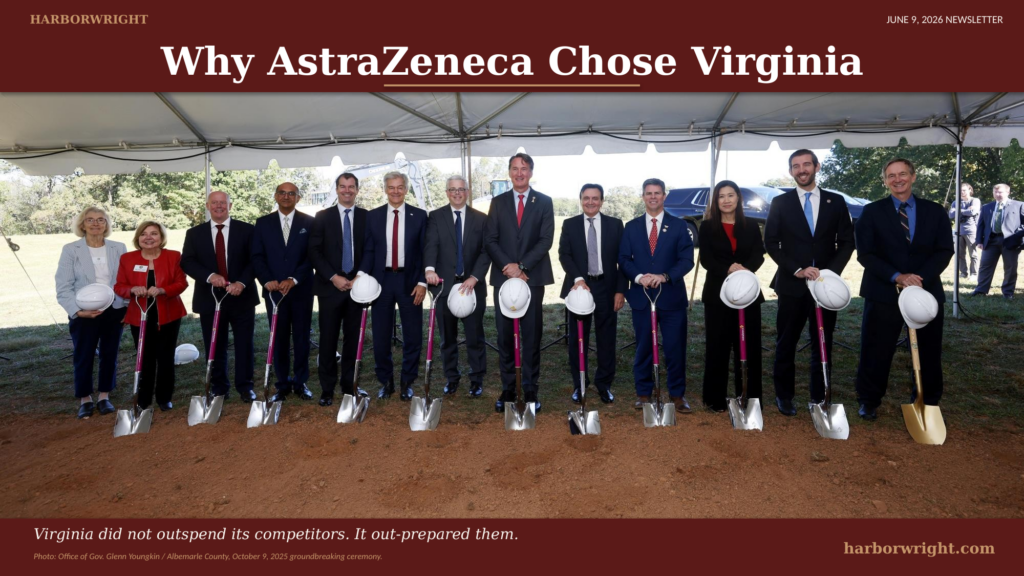
In October 2025, AstraZeneca announced the largest single-facility investment in its 25-year history in Albemarle County, Virginia.
A $4.5B investment creating 3,600 jobs.
The decision was made fast. In just 33 days from meeting with Virginia officials, the investment went public. AstraZeneca’s CEO would later coin a phrase for it: “Virginia speed.”
Virginia did not outspend its competitors. Maryland already hosts AstraZeneca’s U.S. headquarters in Gaithersburg and a $300M cell therapy site in Rockville, the natural incumbent for an expansion. North Carolina has the strongest biotech cluster in the country and an active pharma manufacturing pipeline. Indiana’s LEAP district was built specifically to attract pharma at this scale.
Virginia won due to their ability to work quickly. That reason should reshape how the rest of the country thinks about competing for major industrial commitments.
Money and tax incentives are competitive across all four states. What separates the winners is how quickly they move.
The 33-Day Deal
Pascal Soriot met with Governor Youngkin and VEDP officials in June 2025 during a Virginia trade mission. The conversation moved fast. By the end of the trip, AstraZeneca’s site selection team was preparing to visit Virginia.
A whirlwind tour followed. The site selection team visited multiple shovel-ready sites across the Commonwealth in short succession.
On July 21, 2025, AstraZeneca publicly announced a $50B U.S. investment plan with Virginia as the cornerstone.
That announcement, 33 days from the first meeting, was structural completion of the deal. The October 9, 2025 follow-on announcement expanded the facility to $4.5B, added an antibody-drug conjugate manufacturing site, and raised direct jobs to 600 and total direct-plus-indirect to 3,600.
Pascal Soriot’s framing was direct. “In our company we used to say AZ speed because we want to be fast. Now I’ve found another term, Virginia speed.”
He went further. “Usually this kind of discussion takes months. Sometimes you have a meeting of minds.” And: “the fastest-ever negotiation and fastest-ever deal that we’ve ever committed to.”
Industry baseline for a $4B+ pharma greenfield site selection is 18 to 36 months from initial inquiry to public announcement. Virginia compressed that 20x to 35x faster.
The Package
What Virginia offered was rich but not extraordinary by megaproject standards.
The state package, codified in Senate Bill 527 and signed into law by Governor Spanberger in April 2026, consists of $191.3M from the Major Employment & Investment Commission, up to $34M per year for 20 years from a newly created Pharmaceutical Substance Manufacturing Grant Fund (up to $680M cumulative), an undisclosed Commonwealth Opportunity Fund grant for the second facility, and a $9.7M Virginia Business Ready Sites grant awarded August 2025 to Albemarle County for site infrastructure work.
The package also includes turnkey workforce training through the Virginia Talent Accelerator Program at no cost to AstraZeneca, plus an estimated $709M in local tax revenue to Albemarle County over 25 years.
But the dollars are not why AstraZeneca chose Virginia.
The Structural Advantage
Virginia had the site ready before AstraZeneca asked.
In May 2023, two years before the deal, Albemarle County purchased 462 acres of land adjacent to Rivanna Station for $58M. The land was assembled for “Rivanna Futures,” initially envisioned as a defense and intelligence innovation campus given proximity to the Defense Intelligence Agency, the National Ground Intelligence Center, and the National Geospatial-Intelligence Agency.
In August 2025, after Soriot’s meeting with Virginia officials but before the public announcement, Virginia awarded Albemarle the $9.7M Business Ready Sites grant to extend water, sewer, road access, and grading across the campus.
The site was infrastructure-ready before AstraZeneca’s site selection team toured it.
VEDP’s standing infrastructure compounded that advantage. The Business Ready Sites Program, built up to roughly $500M during Governor Youngkin’s term, was an explicit portfolio of state-graded sites with extended utilities, identified permits, and county partners pre-positioned. The Virginia Talent Accelerator Program delivered workforce training as a turnkey state service. The MEI Commission’s pre-authorized framework for $250M+ capex projects meant the state package could be put on paper without requiring a special session of the General Assembly.
These were not deals VEDP put together for AstraZeneca. They were standing capacities Virginia had built over multiple administrations.
Why Speed Wins Now
Speed has become the binding constraint in major industrial site selection for three reasons.
- Federal incentive deadlines. The Inflation Reduction Act, the CHIPS Act, and the Bipartisan Infrastructure Law create capital deployment windows that close. Projects that cannot break ground inside those windows lose the federal credit stack.
- Tariff and policy volatility. AstraZeneca’s broader $50B U.S. announcement, like Eli Lilly’s parallel commitment, was a direct response to tariff pressure on imported pharmaceuticals. Companies repatriating manufacturing under policy compression do not have 24 to 36 months to negotiate a state package. The pressure is now.
- Buyer-side procurement cycles. Hyperscale customers, federal agencies, and major pharma buyers operate on fiscal-year capacity planning. A plant that opens in 2028 captures a different revenue stream than the same plant opening in 2030.
The states and counties that win the next decade of major industrial commitments will be the ones that can move from inquiry to recommendation in weeks, not months.
What This Means for the Rest of Virginia
Albemarle’s playbook is replicable. It is not free.
Counties that want the next AstraZeneca need 3 things in place before the call comes.
- Build-ready land. Albemarle spent $58M on a speculative land purchase in 2023 with no confirmed tenant. That kind of pre-commitment requires a Board of Supervisors willing to take the risk, a private partner willing to underwrite the position, or a regional partnership pooling capacity.
- Extended infrastructure. The Virginia Business Ready Sites Program grants exist to subsidize the water, sewer, road, and grading work that turns raw land into a site a buyer can break ground on. Counties that do not apply and do not win those grants will not be in the running when speed becomes the differentiator.
- Analytical capacity. When AstraZeneca’s site selection team called Albemarle County, the EDO had the answer ready. Demographic data, workforce flow, utility capacity, tax incentive package math, permitting timeline, neighboring industrial uses. All of it. The counties that win at speed have done the analysis before the call.
That last piece is where most counties fall short.
The Harborwright Method
The work Harborwright does is the third piece.
We turn around economic intelligence reports, site assessment dashboards, and competitive analyses for EDOs and project sponsors within 10 business days.
The reports are decision-grade. Demographic and labor market analysis. Utility and infrastructure readiness. Tax incentive structure. Comparable-deal benchmarking. Competitive positioning against peer jurisdictions. We work directly with local economic development authorities, regional partnerships, and state agencies that need analyst capacity faster than they can hire it.
When AstraZeneca’s team called Albemarle, the county had the analytical answer ready because the analysis had already been done.
That is the standard now. Counties and project sponsors that want to compete for the next major industrial commitment need the same readiness.
Sources
- AstraZeneca commitment details and Pascal Soriot quotations from AstraZeneca press releases (July 21, 2025 and October 9, 2025) and Virginia Business reporting (December 2025).
- Negotiation timeline from Virginia Business, The Center Square, 13NewsNow, and VEDP communications.
- State incentive package detail from Senate Bill 527 reporting (April 2026), Manufacturing Dive, and the Office of the Governor of Virginia.
- Albemarle County land purchase and Rivanna Futures site information from Information Charlottesville (May 2023 and August 2025).