
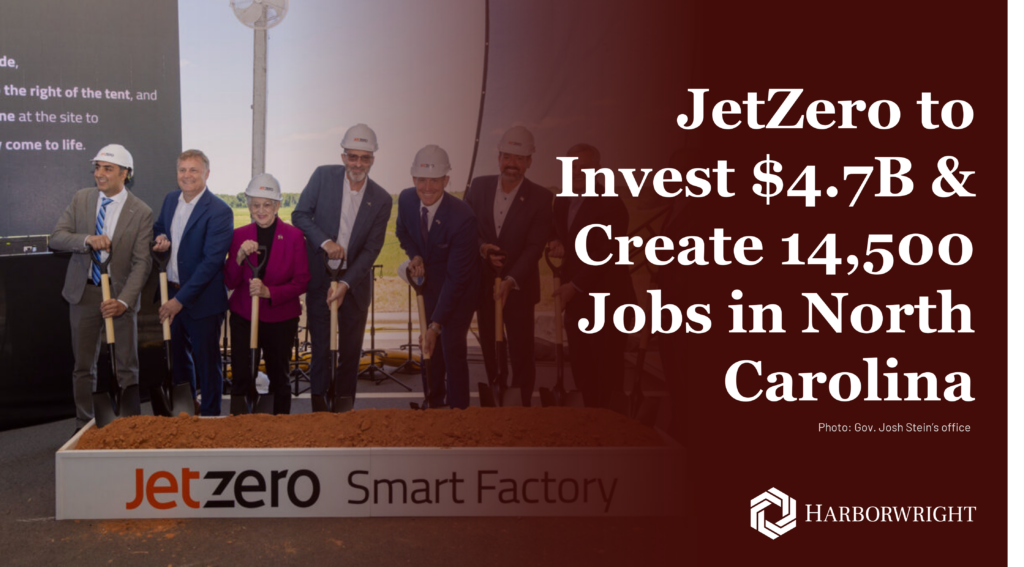
On June 15, 2026, JetZero broke ground at Piedmont Triad International Airport on a 1,000-acre megasite that will become a clean-sheet commercial aircraft factory. JetZero will invest $4.7B in capital creating 14,500 jobs over the next decade. The largest job commitment in North Carolina history.
North Carolina beat Huntsville, Alabama and at least one unnamed third finalist out of 25 sites across 17 states JetZero evaluated. Site selection to shovel took twelve months.
The deal carries weight beyond its dollar figure. JetZero is building a clean-sheet commercial airframe, a blended-wing-body aircraft no manufacturer has ever certified for passenger service. Boeing’s last clean-sheet was the 787, certified in 2011. Airbus’s was the A350, in 2014. Aerospace OEM births are generational events, and they do not pick locations lightly.
The Package
The state package is unusually rich.
The Job Development Investment Grant approved by the NC Economic Investment Committee is up to $1,017,775,800 over 37 years, the largest JDIG in the program’s history, in the Transformative tier created for Toyota in 2021. Performance gates are real. Payments require annual workforce verification. The 29-year tail payments only unlock at 10,000 sustained jobs.
House Bill 125, signed in 2025, appropriates up to $450M directly to site preparation, road, water and wastewater work, and facility construction. $118.1M in FY25-26. $133.9M in FY26-27. $198M phased through FY30-31.
Guilford County added up to $75.9M over 20 years on performance gates. The City of Greensboro committed $1,000 per job over ten years, approximately $14.5M at full hiring. The state Utility Account diversion adds up to $113M to the NC Industrial Development Fund.
Public commitment, all layers stacked, runs about $1.6B against $4.7B of disclosed JetZero capex. That is approximately 34% incentive density.
For comparison: Toyota’s $13.9B Liberty, NC battery plant ran about 5% density on state incentives. FUJIFILM’s $1.2B Holly Springs facility ran about 6%. Boom Supersonic’s $500M Greensboro factory ran about 39%. VinFast’s $4B Chatham County project ran about 18%.
JetZero is the densest large industrial subsidy package North Carolina has ever written by capex ratio.
The Structural Advantage
The reason JetZero chose Piedmont Triad International Airport is what was already there.
PTIA was, before JetZero arrived, an aerospace cluster of approximately 50 on-airport aerospace firms and 9,000 jobs. HondaJet’s world headquarters and manufacturing operation, employing roughly 1,500 across HondaJet and Honda Aero. FedEx Express’s Mid-Atlantic Hub, operational since 2009. HAECO Americas, an MRO acquired by AAR Corp in November 2025. Marshall Aerospace’s $50M MRO facility. Textron Aviation’s Citation and Beechcraft service center, on site for three decades. Boom Supersonic’s 179,000-square-foot Overture Superfactory, completed in 2024.
PTIA’s primary runway is 10,001 feet, with a parallel 9,000-foot strip. Sufficient for the Z4-class aircraft JetZero plans to build.
The site itself, a 1,000-acre contiguous tract, with 200 acres pre-graded at selection and grading underway to 500, had been positioned long before JetZero called. Water and sewer infrastructure was pre-extended. A new taxiway connecting the development area to the runway system was already constructed.
Guilford Technical Community College broke ground in October 2025, eight months before the JetZero announcement, on a $34.6M, 70,000-square-foot Aviation Center in Colfax, minutes from PTIA. It opens spring 2027 with capacity for more than 700 students annually in composites, structures, and avionics.
The Greensboro Urban Loop, I-840, was completed in January 2023, with the I-73/I-840 ramp prioritized for airport access.
These are not deals the Stein administration assembled for JetZero. They were positions built across three governors, Cooper, Stein, and the McCrory administration before them, and across multiple county and airport authority boards.
When JetZero’s site selection team came to North Carolina, the analytical answer was already on the shelf. The runway. The cluster. The megasite. The workforce pipeline. The highway connection.
Why the Triad Won & What It Cost
JetZero raised approximately $1B in cumulative funding through its January 2026 Series B, led by B Capital with Northrop Grumman, RTX Ventures, 3M Ventures, and others. United Airlines and Alaska Airlines hold conditional purchase commitments. The company has roughly 205 employees.
Clean-sheet commercial airliner programs historically cost $14B to $30B to develop. The Boeing 787 ran approximately $32B. The Airbus A350 ran approximately $15B. JetZero is positioned at a fraction of that capital base with a more aggressive design.
The Z4 program’s demonstrator aircraft, the USAF XBW-1, contracted in August 2023 at $235M, is targeted for first flight in 2027. The Z4 commercial entry into service is targeted for the early 2030s. As of late May 2026, the XBW-1 was approximately half built.
The USAF zeroed out $14M in Z4-related funding in its FY26 budget request, redirecting to a Next-Generation Air-refueling System study.
JetZero requested a one-year extension on its hiring milestones from the state, December 2026 to December 2027, nine days before the June 15 groundbreaking, citing North Carolina’s delayed state budget. The JDIG is structurally pay-for-performance and will not pay if employment targets are not met. The $450M state appropriation is upfront, paid into site preparation and facility construction, with limited clawback.
The honest framing: $1.6B of public capacity is being deployed on a company that has not yet flown a full-size aircraft of any kind, in a configuration no FAA certificate has ever covered.
If JetZero delivers, North Carolina has anchored the next generation of commercial aerospace and pulled $4.7B in capital and 14,500 jobs into its workforce base.
If JetZero does not deliver, North Carolina has a fully prepared megasite at PTIA with extended utilities, a new taxiway, an aviation training center, and a 50-firm cluster denser than it was before the bet. The site readiness portfolio carries forward whether or not the specific tenant does.
That is the structural argument for state-led industrial bets done well. The infrastructure earns its keep across the cluster, not on any single deal.
What This Means for the Tri-State
The lesson for economic development offices across Virginia, North Carolina, and South Carolina is the same lesson the AstraZeneca deal carried.
Site readiness is binary. Either the analytical answer is on the shelf when the site selection call comes, or it is not.
The Triad assembled its readiness across twenty years of cluster building. HondaJet in 2005. FedEx Mid-Atlantic Hub in 2009. The Greensboro Urban Loop completion in 2023. The 1,000-acre megasite with pre-extended utilities. The GTCC Aviation Center in 2025. The I-840 ramp to PTIA. None of those decisions were made for JetZero. JetZero became possible because they had been made.
Counties and authorities that want to compete for the next aerospace, semiconductor, life sciences, or critical minerals megaproject need three things in place before the call comes.
- Build-ready land at megasite scale. The Triad’s 1,000-acre tract was not assembled in twelve months. It was assembled across more than a decade of land control and state-aided site preparation.
- Extended infrastructure subsidized by state-level site readiness programs. NC’s Megasite Readiness Program scaled from $1M in 2022 to $100M in 2024. Virginia’s Business Ready Sites Program ran roughly $500M during the Youngkin administration. South Carolina’s site portfolio sits in between. Counties that do not apply and do not win those grants will not be in the running when speed becomes the differentiator.
- Analytical capacity good enough to put a defensible recommendation in front of a site selection team in days, not months. This is where most counties default.
The first two require capital and political risk tolerance. The third is the work most counties cannot do alone.
Sources
- North Carolina Governor’s Office press release, June 15, 2026, and Governor’s Office groundbreaking communications.
- JetZero press release and investor materials, June 12, 2025 and June 15, 2026.
- Economic Development Partnership of North Carolina, JDIG approval documentation.
- North Carolina House Bill 125 appropriation text and Carolina Journal reporting.
- Triad Business Journal, Greensboro News & Record, and WRAL TechWire reporting (June 2025 – June 2026).
- Aviation Week and Air & Space Forces Magazine reporting on the JetZero XBW-1 demonstrator program.
- Bloomberg coverage of JetZero Series B financing, January 2026.
- Piedmont Triad International Airport (flyfrompti.com) and Piedmont Triad Airport Authority site documentation.
- Guilford Technical Community College Aviation Center announcement, October 2025.
- Cross-jurisdictional incentive comparison from NC Commerce, Carolina Journal, and VEDP comparable deal data.