

Part 2 of the Virginia Economic Intelligence Series
In our first article in this series, we explored Virginia’s Housing Affordability Index and what it means for families trying to put down roots in the Commonwealth. Housing costs tell one side of the story. But there is another cost quietly reshaping household budgets across Virginia, and it is accelerating: electricity.
The average Virginia household is projected to spend $2,059 on electricity in 2025. By 2030, that figure climbs to $2,253—a compound annual growth rate of 1.82%. That may sound modest in isolation. But zoom into specific counties, and the picture changes dramatically.
What makes this moment different is that electricity costs in Virginia are no longer driven solely by inflation or fuel markets. They are increasingly shaped by the explosive growth of data centers—and by the policy battles over who should bear the cost of powering them.
The Numbers: Electricity Costs Are Rising Unevenly
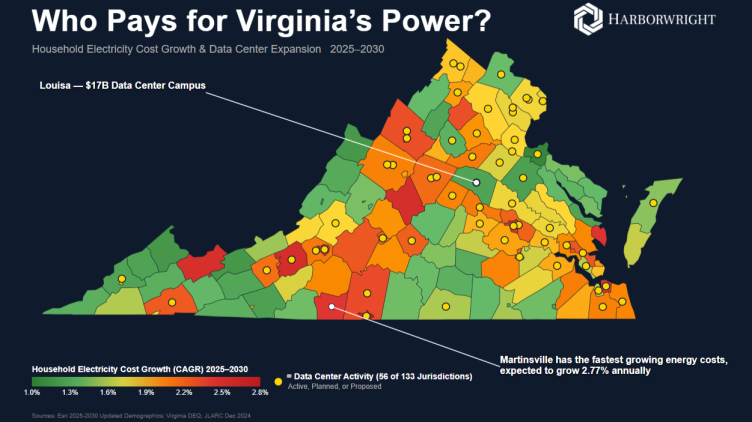
Across Virginia’s 133 counties and independent cities, per-household electricity costs in 2030 range from under $1,300 to nearly $4,200. The variation is striking, and it follows a pattern that should concern economic development professionals and local officials alike.
In Loudoun County—the epicenter of America’s data center industry—the average household is projected to spend $3,779 per year on electricity by 2030. Prince William County, the second-largest data center market, comes in at $3,001. Fairfax County follows at $2,945.
These are not rural counties struggling with aging infrastructure. They are among the wealthiest jurisdictions in the nation. And yet their residents face electricity costs 40–70% above the statewide average.
Source: Esri 2025–2030 Updated Demographics; Harborwright data center research.
But the CAGR tells a more nuanced story. Some of the fastest growth rates are not in Northern Virginia. Counties like Louisa (2.15% CAGR), Henrico (2.15%), and Chesterfield (2.03%) are experiencing above-average electricity cost growth—and all three are in the middle of a data center construction boom.
The Data Center Footprint: 56 of 133 Jurisdictions and Growing
Our research identified data center activity—existing facilities, approved projects, or formal proposals—in 56 of Virginia’s 133 counties and independent cities. That is 42% of the Commonwealth’s jurisdictions, up from a handful just a decade ago.
Virginia hosts roughly 598 data center facilities consuming an estimated 5,050 megawatts of power. Dominion Energy forecasts that data center peak demand will reach 9 gigawatts within the next decade—enough to power every home in the state twice over.
The concentration remains staggering. Loudoun County alone holds approximately 72 active permits and 2,500+ megawatts of capacity. But the footprint is expanding rapidly along two corridors:
The I-95 Corridor stretches from Fairfax County through Stafford, Spotsylvania, and Fredericksburg into the Richmond metro. Fredericksburg alone has $12 billion in announced projects, including a $10 billion Stack Infrastructure campus and Vantage Data Centers’ $2 billion, 192-megawatt VA4 facility.
The Richmond Ring encompasses Henrico, Chesterfield, Powhatan, Hanover, and Goochland counties. Google’s $9 billion investment in Chesterfield anchors this market, while Powhatan approved a $2.7 billion campus in late 2024. The Richmond market surged from 100 to over 800 megawatts of capacity in the first half of 2025 alone.
Beyond these corridors, some of the most ambitious proposals are in places few would have predicted. EdgeCore’s $17 billion, 1.1-gigawatt campus in Louisa County would be the single largest data center project ever announced in Virginia. Aligned Data Centers’ SAC III project at the Berry Hill megasite in Pittsylvania County carries a $73 billion price tag and, if fully built, could become one of the largest data center complexes in the world.
The Policy Collision: Governor Spanberger’s PJM Coalition
In April 2025, Governor Abigail Spanberger led a bipartisan coalition of seven governors and the Mayor of Washington, D.C. in signing a letter to PJM Interconnection—the nation’s largest electric grid operator, which manages the transmission system serving 65 million people across 13 states.
The letter outlined three demands that signal a fundamental shift in how Virginia and its neighbors intend to manage data center growth:
First, ratepayer protections. The governors argued that residential customers should not subsidize the transmission infrastructure required by data centers. When a hyperscale facility requires hundreds of millions of dollars in grid upgrades, the coalition demanded that those costs be borne by the entities creating the demand—not spread across every household’s monthly bill.
Second, cost causation. The letter called for PJM to reform its cost allocation methodology so that the entities driving new infrastructure needs pay their proportional share. Under the current system, transmission upgrades triggered by data center load growth in Northern Virginia can be allocated across the entire PJM footprint, affecting ratepayers in Ohio, Pennsylvania, and beyond.
Third, technology neutrality. The governors urged PJM to adopt generation-agnostic planning that does not favor one energy source over another, ensuring a diversified and resilient grid as demand accelerates.
This is not just a Virginia issue. It is a regional reckoning with the reality that data center electricity demand is growing faster than the grid can accommodate it, and the current framework does not adequately assign the costs of that growth to the parties causing it.
What This Means for Economic Development
For Virginia’s economic development professionals, this data creates both challenges and opportunities.
The challenge is that rising electricity costs erode the affordability proposition that attracts both businesses and residents. A county that markets itself as a lower-cost alternative to Northern Virginia may find that advantage disappearing as data center-driven grid investments push rates higher across the entire Dominion service territory.
The opportunity is in the data itself. Counties that understand their electricity cost trajectory, their proximity to data center infrastructure, and the policy landscape around cost allocation can position themselves far more strategically—whether they are courting data center investment or trying to protect their residents from its side effects.
Consider this: of the 56 jurisdictions with data center activity, only 28 have operating facilities. The remaining 28 are in various stages of planning, proposal, or regulatory preparation. Many of them—like York County, James City County, and Albemarle County—are proactively adopting zoning frameworks before a single application arrives. Others, like Chesapeake and Fauquier County, have formally rejected proposals.
The jurisdictions that will navigate this transition most effectively are those that start with the data: what are our current electricity costs, where are they headed, what infrastructure exists or is planned, and what policy tools are available to ensure growth benefits residents rather than burdening them.
Looking Ahead
Virginia’s electricity landscape is being reshaped by forces that were barely visible five years ago. The convergence of AI-driven data center demand, grid capacity constraints, and multi-state policy coordination through PJM creates a moment of genuine structural change.
In our next article in this series, we will examine water consumption—another resource that data centers require in enormous quantities, and one that is creating its own set of conflicts in communities across the Commonwealth.
The data is clear. The question is whether Virginia’s communities will use it to shape their futures—or be shaped by it.
Data Sources: Electricity Costs: Esri 2025–2030 Updated Demographics | Data Center Activity: County planning documents, VEDP, DataCenterDynamics, local news sources | PJM Coalition Letter: Office of Governor Abigail Spanberger, April 2025 | Grid Demand Forecasts: Dominion Energy IRP; PJM Interconnection