

Housing affordability did not become a Virginia problem overnight. It was built over a decade of rising construction costs, lagging housing production, wage growth that could not keep pace with home prices, and local zoning frameworks that were never designed for the demand pressures they face today. By the time the data caught up, the gap between what Virginia households earn and what Virginia housing costs had become a structural condition.
In her first 100 days, Governor Spanberger signed 16 housing bills into law and Executive Order 3 creating the Commission on Unlocking Housing Production. A cabinet-level review of every regulatory barrier in the state. The Affordable Virginia Agenda is the most comprehensive state housing initiative Virginia has seen, and it involves cooperation at both the state and local jurisdictions.
To better help developers, homebuilders, and county economic development directors, we are starting a series of articles to discuss the issue of housing in Virginia, state law, how it is impacting local communities, and how different professionals may approach these issues.
The Statewide Picture
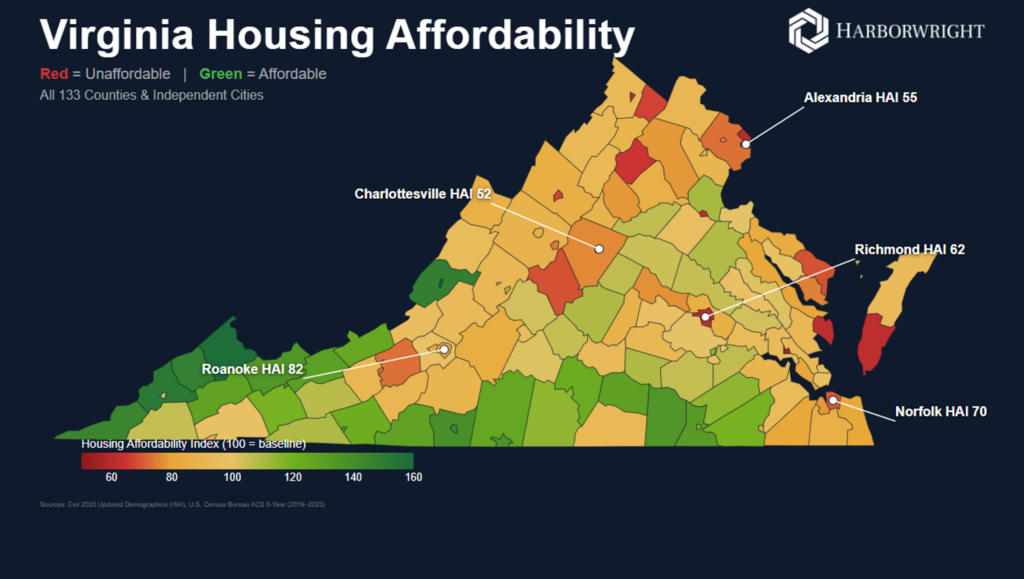
The median Housing Affordability Index (HAI) across Virginia’s 133 jurisdictions is 93. An HAI of 100 means the median household can afford the median home. Below 100 means they cannot. Virginia’s median sits below that line, the result of years of compounding pressures that continue to strain the average Virginian.
A staggering 48% of Virginia renter households are paying 30% or more of their income on housing. Nearly 25% percent are paying more than half their income on rent. 27 jurisdictions have an HAI below 80, meaning the affordability gap is not just tight but structurally and severely unaffordable. 40 jurisdictions have a majority of renters who are cost-burdened.
These numbers are real conditions that accumulated long before 2026. They are the starting line that the Virginia Government is working to address.
Where the Pressure Is Greatest
Charlottesville has the lowest Housing Affordability in the state at 52. A household earning the local median income would need to spend roughly 46% of its income on mortgage principal and interest alone. More than 56% of Charlottesville renters are cost-burdened; 31% are severely cost-burdened.
Alexandria (HAI 55), Falls Church (56), Williamsburg (57), and Arlington (61) round out the five lowest. But the data reveals that the affordability challenge extends well beyond Northern Virginia: Richmond (HAI 62), Winchester (62), and Northampton County (62) are in the same tier. Over half of Norfolk and Virginia Beach renters are cost-burdened.
This is not a Northern Virginia story. It is a statewide one and that is exactly why statewide policy tools matter. And yet, each individual county has its own unique geography, employment, jobs base, and housing issues, requiring cooperation between state and local governments.
The Rural Dimension
Western Virginia looks far more affordable. Covington (202), Buchanan County (158), and Wise County (152) are among the highest in the state. But affordability where demand is soft and wages are low presents a different challenge, one of economic capacity, not housing supply. These communities need investment and job creation alongside any housing strategy. They cannot simply be ignored because they are affordable.
The Shenandoah Valley tells a more nuanced story. Rockingham County (HAI 85), Augusta County (88), and Staunton (86) sit in the moderate zone, but over 40% of their renters are cost-burdened. These are working communities where housing costs are outpacing incomes, exactly the kind of places where the governor’s new policies will have measurable difference.
What the Governor’s Agenda Puts on the Table
The Affordable Virginia Agenda gives every jurisdiction in the state new capabilities that did not exist a year ago:
HB867 opens density bonuses and affordable housing programs to all localities for the first time. Statewide ADU by-right takes effect July 1, removing one of the most common local barriers to incremental housing supply. HB806 enables EDAs and IDAs to issue bonds for residential development, giving economic development authorities a direct financing tool for housing. The $25 million mixed-income revolving loan fund (HB820) begins in FY2027, creating a new capital source for projects that serve middle-income households.
These are real levers. The question for every county and independent city is the same: what do our local conditions look like, and which of these tools fits? And most importantly, how do we implement it?
What This Series Will Cover
This is where Harborwright comes in. Over the coming weeks, we will publish a series of deep dives examining Virginia’s housing landscape from multiple angles:
The regional breakdowns, Northern Virginia, Hampton Roads, the Shenandoah Valley, Southwest Virginia, the Virginia Coast, and the Richmond metro, each with their own affordability profile and their own set of applicable policy tools. The specific bills and what they mean for different types of jurisdictions. Our biggest priority is researching the intersection of housing affordability and economic development, because any local economic development expert trying to attract investment to a community where workers cannot afford to live is fighting with one hand tied.
If you work in economic development, housing policy, or community investment in Virginia, this series is built for you.
The Data Is Available
We compiled the complete Virginia housing affordability picture into a single workbook: all 133 jurisdictions, Housing Affordability Index (Esri 2025), renter cost-burden rates at the 30 percent and 50 percent thresholds (U.S. Census ACS 5-Year, 2019–2023), homeowner cost-burden rates, average energy costs, and a heat map showing the affordability gradient across the state. Every formula traces back to the underlying data. Every metric ships with its source and vintage.
Governor Spanberger’s administration is building the policy infrastructure. The data infrastructure needs to keep pace. That is the work we are doing — and we are starting with Virginia because the opportunity here is immediate.
About the Author: Matt Hayes is the Managing Director and Co-Founder of Harborwright, an economic development intelligence firm based in Charleston, South Carolina. Harborwright delivers market research, competitive analysis, and AI-powered dashboards on a flat annual retainer. Learn more at harborwright.com.