36 followers
By: Matthew Hayes | May 5th 2026 | Harborwright
Any business competes for strong local workers. Those workers compete for the same houses. When the houses don’t get built, the workers move, and the tax base, the employer pipeline, and the quality of life follow them.
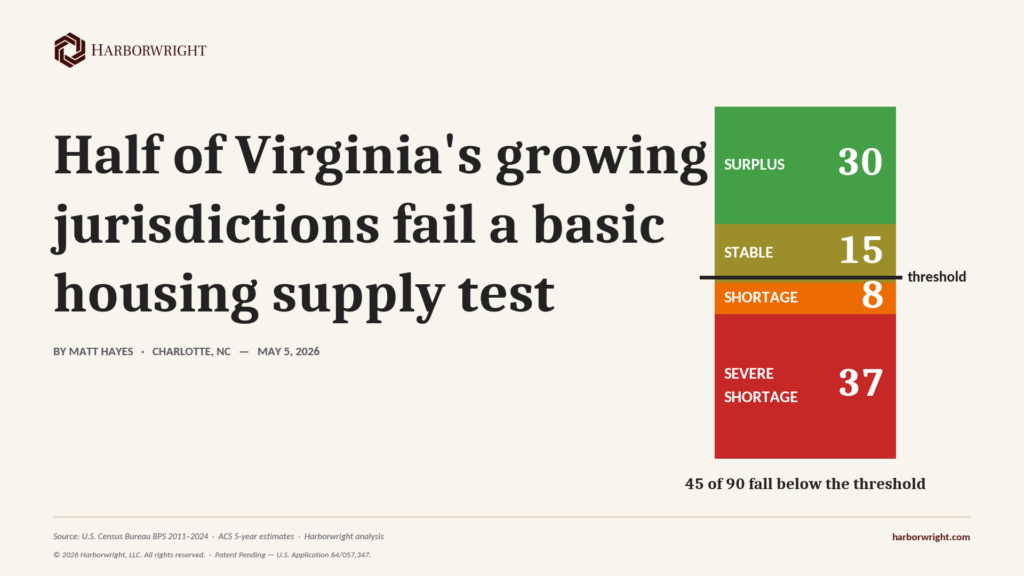
Half of Virginia’s growing jurisdictions are facing a housing shortage.
This article explains the basic rule that decides if a jurisdiction is permitting at a surplus to house enough workers, and then walks through what failure costs and what surplus delivers.
THE RULE
A housing market is in balance when permits run at 1.10 for every new household. The buffer matters. It absorbs natural vacancy, replaces stock lost to age and demolition, and gives a market the capacity to grow without prices spiking.
Below the threshold, a market falls behind every year. Between 1.0 and 1.10, it’s marginal. Above 1.30, it produces enough housing to meet new demand and absorb workforce growth comfortably.
THE TEST
The math runs in two steps for every jurisdiction.
1. Step one: Count the new households a jurisdiction added between 2010 and 2024.
Multiply by 1.10
That’s the housing the jurisdiction needed to build to keep its market in balance, covering the new households themselves plus a small buffer for vacancy and replacement.
2. Step two: Count the building permits issued between 2011 and 2024
Multiply by 0.90
Why 0.90?
Because not every permit becomes a finished home. Some get pulled but never built. Others take years to complete. The U.S. Census Bureau tracks both authorized permits and completed units in two separate surveys. Over the last decade, between 85% and 92% of issued permits converted to completions, depending on the construction cycle. We use the midpoint, 0.90, as a conservative estimate of how many permits actually deliver housing. That’s what the jurisdiction actually built.
Divide what was built by what was needed. If the answer is at or above 1.0, the jurisdiction kept up. Below 1.0, it fell behind. The deficit compounds every year.
We applied this to all 133 Virginia jurisdictions. 43 are shrinking, they need replacement permits, not new units. The 90 growing jurisdictions are where the rule applies, and the cumulative picture is stark.
Across all 90 growing markets, Virginia underbuilt by 21,735 units over 14 years. That’s the cumulative miss.
THE BREAK DOWN
Inside the 90 growing jurisdictions, the picture is a 50/50 split. 45 jurisdictions cleared the threshold. 45 fell at or below it.
Behind that split is a stack of consequences for the half that didn’t, workforce shortages, business attraction problems, affordability collapses, tax base risk.
THE LOUDOUN COUNTY
Loudoun County is the data center capital of the world. Personal property tax revenue from data centers grew from $60 million in FY 2013 to over $800 million by FY 2026. In tax year 2025, data centers made up 73% of the county’s commercial real estate portfolio. The economy is roaring.
The workforce that runs the county can’t afford to live there.
Loudoun grew its population by 35% over the last decade. Housing supply did not keep pace. The county now faces a shortage of 11,200 rental units, 10,000 of them for families earning below 80% of area median income. Teachers, first responders, hospitality workers, and young professionals, the people the county relies on every day, are pushed out to cheaper markets. The workers who do stay drive in from Frederick, West Virginia, and Maryland.
Under the 1.10x rule, Loudoun ran at 0.85x over the last 14 years. The county built 6,949 fewer housing units than its growth required, the second-largest absolute deficit in Virginia.
By growing at only 85% of the rate required to house its new workers, Loudoun effectively “exported” its workforce to Jefferson County, WV, and Frederick, MD.
The economic consequence is now visible. Tech employers compete for the same workforce as data center construction crews and federal contractors. The teachers and EMTs who hold daily-life infrastructure together are quitting because they can’t afford the commute. The county is responding, Loudoun has directed tens of millions of data-center tax revenue into a housing trust fund and is contributing annually to a revenue-stabilization fund. The fund is the fix. The 6,949-unit deficit is the question of how long it takes to dig out.
Loudoun is not alone at the top of the deficit list. Prince William, Richmond city, Stafford, Alexandria, Virginia Beach, Chesapeake, and Hampton all run below 1.10x. The supply gap concentrates exactly where the state most needs it to close.
WHAT SURPLUS DELIVERS, HENRICO COUNTY
Henrico County permits 1.68 homes for every new household. It’s running the largest surplus in Virginia.
The county’s $60 million Affordable Housing Trust Fund is paid for by data-center tax revenue and is funding 150 moderate-income homes per year for buyers earning between 60% and 120% of area median income. Three hundred and eighty-three units have already broken ground. Thirty buyers have closed on newly-built homes, with average buyer assistance of $80,000.
Private investment continues to land. Berkley Insurance, Sentara Health, DPR Construction, and Owens & Minor each announced location or expansion plans in the county. Employers go where the workforce is housed.
And the most counterintuitive return: Henrico cut its real estate tax rate by 2 cents in FY26. At 83 cents per $100 of assessed value, it now runs the lowest property tax rate among Virginia’s ten largest localities. A surplus housing supply makes lower tax rates possible because the tax base grows faster than the spending obligation.
HOW JURISDICTIONS POSITION THEMSELVES BETTER
The work is replicable. The policy stack matters more than the geography or the demographics. Three moves separate the 45 jurisdictions that cleared the threshold from the 45 that didn’t.
1. By-right multifamily zoning on transit corridors
Henrico’s R-5B classification permits multifamily without discretionary approval. The result is shorter timelines, lower carrying costs for developers, and projects that actually pencil. Norfolk’s recently-completed citywide zoning rewrite follows the same logic. Both of them clear the 1.10x bar.
2. A dedicated, rule-driven affordable housing fund
Henrico’s $60M trust fund runs on data center tax revenue. Richmond city’s recently-approved 2.5% real estate tax revenue dedication is the equivalent move. The mechanism matters less than the predictability, developers can plan against a stable funding stream.
3. A comprehensive plan that ties housing supply to economic development goals explicitly
HenricoNext does this. So does Suffolk’s plan. The jurisdictions that treat housing as a separate line item from workforce attraction and tax base growth are the ones running below the threshold.
None of these moves require new state legislation. None require new federal funding. They require political alignment between a board willing to legislate and a planning department capable of executing.
For more insights, be sure to subscribe to our newsletter.
SOURCES
- U.S. Census Bureau Building Permits Survey 2011–2024
- American Community Survey 5-year estimates (2010, 2024)
- Esri 2025 Updated demographic estimates
- Joint Center for Housing Studies
- Freddie Mac Economic & Housing Research
- FRED St. Louis Fed; Loudoun County housing data and FY26 budget
- Loudoun Chamber Workforce Housing initiative
- Henrico County FY26/FY27 budget documents
- Time Magazine reporting on Henrico data-center revenue housing program (March 2026)
- Data Center Frontier reporting on Loudoun data-center economic profile.
About Harborwright
Harborwright is an economic development intelligence firm that translates complex data into actionable insights for communities, organizations, and leaders across Virginia and beyond. Our work sits at the intersection of demographic analysis, policy research, and strategic communication.
About the Author
Matthew Hayes is the Managing Director and Co-Founder of Harborwright, an economic development intelligence firm based in Charleston, South Carolina.