36 followers
By: Matthew Hayes | May 5th 2026 | Harborwright
When a city under-permits for 14 years, the people who suffer first are the people who hold the city together. Teachers move farther from the schools they teach in. Nurses drive longer to the hospitals they staff. Hospitality workers, retail staff, young professionals, the workforce a city depends on every single day, get priced out, then leave.
Richmond city has been losing this race for 14 years.
Last week we applied the 1.10x rule across all 133 Virginia jurisdictions. Today we look at the metro where the rule’s sharpest contrast lives.
THE NUMBERS
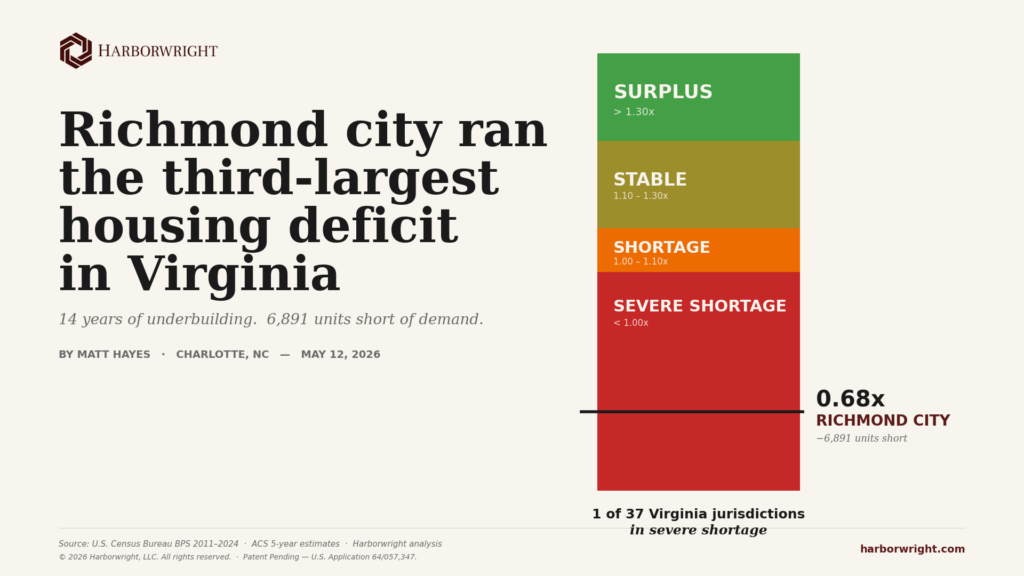
Richmond city, from 2010 to 2024, added 19,599 new households. In that same period, it issued 16,298 housing permits. At Census-rate completion (~90%), that’s 14,668 finished units against 21,559 required at the 1.10x balance ratio, a deficit of 6,891 units.
With a permit-to-household-formation ratio of 0.68x, Richmond City posesses the third-largest gap among Virginia’s 90 growing jurisdictions, behind only Prince William and Loudoun. By ratio, Richmond is in the bottom quartile of the state.
Half of Richmond City’s resident renters cannot afford the city they live in. Of 55,191 renter households, 15,944, roughly 1 in 4, pay more than half of their income on rent. The overall renter cost-burden rate sits at 52.7%. That is the highest severe-burden share of any independent city in Virginia.
Households that pay more than half their income on rent have no margin. A car repair becomes a missed rent payment. A doctor’s bill becomes credit-card debt the household will not pay off this year. Emergency funds run dry. Savings never start. Children move schools more often. Stability, the single largest predictor of educational outcomes, employment continuity, and long-term wealth-building all erode as affordability worsens.
The cost extends past the renter. When workers cannot afford to live near the jobs they leave, while employers struggle to staff. Tax revenue compresses against rising service demand. Civic institutions, schools, hospitals, transit, all work harder on the same budget. The community as a whole pays.
Underbuilding compounds. Every year a market doesn’t add enough supply to absorb its new households, the rent rises faster than the income. Every year that gap widens, more households tip into severe burden. Richmond’s 14-year arc is what that compounding looks like.
THE NEIGHBOR
Richmond City’s neighbor, Henrico County, added 12,696 new households in that same period. It permitted 21,286 residential units and we estimate 19,157 were completed leaving a surplus of 5,191 against the 1.10x ratio. The only large-population jurisdiction in Virginia comfortably above the surplus threshold.
Henrico runs on a four-policy stack: an Affordable Housing Trust Fund anchored to data-center tax revenue, R-5B by-right zoning, the 2025–2030 Consolidated Plan, and the HenricoNext comprehensive update. We covered the mechanism in the April 28 briefing. Link in the comments.
THE METRO
The Richmond metro as a whole, 8 jurisdictions including the city, builds an estimated 0.95x homes per new household. The combined market is failing Harborwright’s 1.10x test to sustain a balanced housing market.
Henrico County,12 miles east, has added 12,696 new households over the past 14 years. Harborwright’s methodology estimates with 21,286 issued permits, it completed 19,157 housing units, giving it a surplus of 5,191 housing units.
Strip Henrico out. The remaining seven jurisdictions run at 0.81x, 4,080 units behind. Henrico is carrying much of the metro’s supply numbers.
WHAT JUST CHANGED
On February 9, Mayor Danny Avula and Councilmember Ellen Robertson introduced a redesigned Richmond Affordable Housing Trust Fund ordinance. Beginning July 1, 2026, 2.5% of all real estate tax revenue collected by the city is dedicated to the trust fund, a predictable, formula-driven funding stream replacing the previous discretionary mechanism. Mayor Avula has committed $40 million in the city’s new budget to back it.
THE FUTURE
Will the 2026 reforms close a gap that took 14 years to open?
The math says they have to be sustained. A 6,891-unit deficit, distributed over 14 years, is roughly 490 units a year. Closing the gap inside a decade requires permitting at roughly 1.30x household formation, surplus territory. That will have to follow Henrico’s execution for the next 10 consecutive years.
Three things will determine whether Richmond’s reforms compound.
- Whether the zoning rewrite, when it passes, includes by-right multifamily on transit corridors
- Whether the trust fund’s 2.5% dedicated stream survives the next budget cycle without erosion
- Whether the city’s planning capacity grows fast enough to process the permit volume the reforms enable.
If those 3 hold, the 2032 numbers look very different from the 2024 numbers. If any one fails, the deficit widens.
METHODOLOGY & SOURCES
- U.S. Census Bureau Building Permits Survey (BPS), 2011–2024, summed by jurisdiction.
- U.S. Census Bureau American Community Survey 5-year estimates for 2010 and 2024.
- Renter cost-burden data: ACS 2023 5-year, Table B25070 (gross rent as a percentage of household income).
- City of Richmond Office of the Mayor press releases (February 9, 2026); Department of Planning and Development Review zoning rewrite documentation
- The 1.10x rule applies a two-step adjustment: permits multiplied by 0.90 to estimate completions (Census BPS-to-completions historically runs 85–92%); net new households multiplied by 1.10 to set the housing requirement. The 1.10x rule is a Harborwright synthesis. Its components are established. Its closest published analog is Up for Growth’s annual Housing Underproduction methodology. Theoretical foundation: Glaeser and Gyourko (2018), “The Economic Implications of Housing Supply,” Journal of Economic Perspectives.
About Harborwright
Harborwright is an economic development intelligence firm that translates complex data into actionable insights for communities, builders, developers, and investors. We publish the Harborwright Briefing every other Tuesday — a wire-service-voice analysis of Virginia, North Carolina, and South Carolina housing supply, workforce, and economic dynamics
About the Author
Matthew Hayes is the Managing Director and Co-Founder of Harborwright, an economic development intelligence firm based in Charleston, South Carolina.