

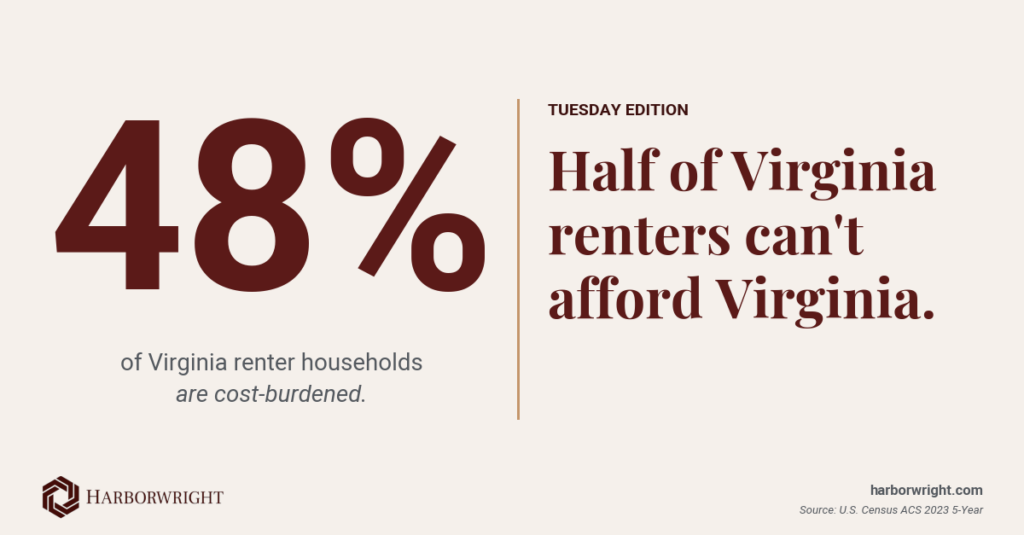
Nearly half of Virginia’s renter households are cost-burdened and some communities are much higher than the state average.
The math behind a 50% rent ratio.
When half of a paycheck goes to rent, the rest of a life starts to buckle quietly. Dining out at restaurants becomes risky. Emergency funds deplete. The retirement contribution stops. The credit card balance grows. One surpise ER bill, one missed paycheck, one sick week, and the eviction filing lands on the kitchen table.
This isn’t a hypothetical. It is the monthly reality for roughly nearly half of all Virginia renter households in 2025. 1 in every 4 people households spend more than HALF of their income on rent. It’s the ICU nurse commuting 70 minutes each way to a hospital that can’t keep enough nurses. The elementary-school teacher whose district is losing half her cohort every three years because no one can afford to stay. These are harsh realities for many Virginians and the issue not only affects renters, but employers and local communities trying to retain and attract jobs.
Nearly half of Virginia’s renters are already over the line.

Of Virginia’s 1 million renter households in 2025, 48.0% are cost-burdened (spending 30% or more of gross income on rent) and 23.6% are severely cost-burdened (spending 50% or more). HUD has used the 30% threshold since 1981. It is the line above which households start trading off food, medical care, childcare, and savings to make rent. Half the state is over it. A quarter of the state is far past it.
The state average hides where the pain actually is.

9 Virginia jurisdictions that sit above the state’s 48.0% renter cost-burden rate, ranked. Severe-burden share (50%+) shown next to each bar. Source: ACS 2023 5-Yr estimates (B25070).
When you break Virginia into its 18 largest jurisdictions, the cost-burden rate ranges from 40% in Arlington to 56% in Chesapeake. That’s a 15-point spread across jurisdictions that mostly sit inside the same labor sheds.
The tidewater markets are where it lands hardest. Chesapeake, Hampton, Norfolk, and Virginia Beach all show 52%+ of renter households cost-burdened, every one of them with severe-burden shares north of 24%. These are the jurisdictions where defense payroll, port activity, and service employment should be creating housing stability. The distribution says they aren’t. If you’re an economic development director in Hampton Roads, the shipyard hire who can’t find a stable rent near the yard is your retention problem, not the housing authority’s.
Richmond city is carrying the state’s worst severe-burden share. At 28.9% severely cost-burdened, the capital is higher than Hampton, higher than Norfolk, higher than Chesapeake. Roughly 16,000 Richmond renter households spend half or more of their income on rent, more than the entire renter population of Fredericksburg and Hanover combined. Richmond’s renter distribution looks more like Hampton Roads than like the rest of the Richmond MSA, which is a capital-city workforce signal that deserves its own newsletter.
Northern Virginia looks better than expected but Prince William is still struggling. Arlington, Loudoun, Alexandria, and Fairfax all land below the state average despite having the highest rents in Virginia, because incomes keep pace. Rent level alone isn’t the policy signal. Rent-to-income is. Prince William sits at 49.9%, right at the state line which says exurban growth is pulling in a more rent-stressed renter mix than inner NoVA absorbs.
What this does to the community .
Severe cost burden doesn’t stay in the renter’s apartment. It spills into every metric the jurisdiction tracks.
It shows up in the school district. A family that moves every 11 months, because rent went up, because the landlord sold, because the roommate left, pulls the kid out of second grade mid-year. Chronic absenteeism rises. Proficiency scores drop. The school board raises the issue at the county board meeting as an education problem. It isn’t. It’s a housing problem metastasizing into the classroom.
It shows up in the ER. Cost-burdened households skip preventive care because a copay is the difference between rent and groceries. A manageable condition becomes an ambulance ride. The hospital eats the uncompensated cost. The insurer reprices the county’s risk pool. Premiums move up for every employer on the books.
It shows up in the employer’s exit interview. The junior analyst who took the job for $68K leaves in 18 months because they priced out the two-bedroom they needed when the baby came. The company fills the seat from Raleigh, from Charlotte, from Greenville, places where the same salary still buys a life. The EDO’s hard-won recruitment win leaks out the back door.
It shows up in the eviction filing clerk’s queue. Virginia’s Tidewater circuits run some of the heaviest eviction dockets in the state. Every filing is an employer who just lost a shift, a school that just lost a child, a landlord who just lost six weeks of rent, and a family whose credit report got a ten-year anchor. The cost of a single eviction, measured across employer, landlord, school, court, and social services, runs into the thousands per case.
This is what a 55.6% cost-burden rate looks like at the ground level. The distribution is not just a chart. It is the explanation for why your comprehensive plan update keeps running into headwinds your neighbors three counties over don’t seem to face.
How Virginia can address the Affordable Housing Crisis
This is a partnership problem. State housing leaders can identify and target new production and even allocate resources to those painpoints. Counties and cities can help identify critical sites, set the zoning, and shape the incentives that decide where those units land. When the two sides work from the same cost-burden distribution, and build for the brackets where rent is actually crushing households, not the brackets already clearing, new housing relieves the burden instead of just moving a number. That is how Virginia turns an affordability crisis into jobs, employers, and workforce that stay.
At the end of the day, housing will alway be a local issue and require local cooperation.
About Harborwright
Harborwright is an economic development intelligence firm that translates complex data into actionable insights for communities, organizations, and leaders across Virginia and beyond. Our work sits at the intersection of demographic analysis, policy research, and strategic communication.
About the Author
Matthew Hayes is the Managing Director and Co-Founder of Harborwright, an economic development intelligence firm based in Charleston, South Carolina.
Sources
- Esri Updated Estimate from ACS 2023 5-Year estimates (Table B25070: Gross Rent as a Percentage of Household Income in the Past 12 Months).